
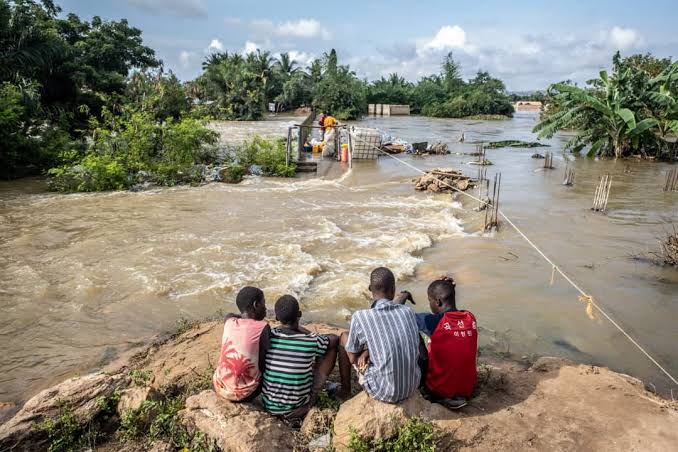
…Gov’t’s response must become lasting reform
Government has responded with a series of immediate interventions. The declaration of July 10 and 11 as National General Cleaning Days across seven flood-affected regions reflects an acknowledgement of the urgency of the crisis. Speaker Alban Bagbin’s decision to suspend parliamentary sittings to allow Members of Parliament from affected constituencies to participate in the exercise also sends a strong political signal that flood prevention demands collective action.
These are welcome measures.
Yet Ghana’s flood response cannot remain seasonal. Clearing drains after every major downpour may reduce immediate risks, but it does little to address the structural causes of flooding. National clean-up exercises should become part of a sustained sanitation culture, backed by continuous public education, stronger enforcement and institutional reforms. Flood prevention should be embedded in public policy rather than activated only after disaster strikes.
CCLG-Africa’s blueprint for resilience
This is where Climate Communications and Local Governance-Africa (CCLG-Africa) believes Ghana must fundamentally rethink its approach.
For years, the organisation has argued that flooding should no longer be treated merely as an emergency management issue but as a climate adaptation and governance challenge. The latest disaster reinforces that argument.
CCLG-Africa advocates a shift from reacting to disasters towards building resilient communities capable of living with a changing climate.
At the heart of its approach is nature-based adaptation. Wetlands, forests and river buffers are not idle land waiting for development; they are natural infrastructure. Healthy wetlands absorb excess rainfall, forests slow surface runoff and reduce erosion, while rivers require space to overflow safely during extreme weather events. Protecting and restoring these ecosystems would reduce flood risks while enhancing biodiversity, improving water quality and contributing to Ghana’s climate commitments.
The organisation also argues that waste management must become a climate policy, not merely a sanitation issue. Every flood in Accra exposes the same uncomfortable reality: plastic waste has become part of the city’s drainage system. Choked drains prevent water from flowing naturally, transforming heavy rainfall into destructive floods. CCLG-Africa therefore advocates stronger waste segregation, investment in recycling, tougher enforcement against indiscriminate dumping and sustained public education capable of changing behaviour beyond periodic clean-up campaigns.
Equally important is climate-smart urban governance. Planning authorities must enforce building regulations before disasters occur rather than demolishing structures afterwards. Flood-risk assessments should guide new developments, while encroachment onto wetlands and waterways must attract swift sanctions. Metropolitan, Municipal and District Assemblies require greater technical capacity, more environmental officers and stronger coordination if planning laws are to be enforced consistently.
CCLG-Africa further advocates investment in early warning systems and climate-risk financing. Communities need reliable weather forecasts delivered in time to prepare, while innovative mechanisms such as parametric flood insurance can automatically release financial support once rainfall exceeds predetermined thresholds, enabling households and farmers to recover more quickly.
Institutional reforms are equally important. The organisation has consistently called for the establishment of a National Sanitation Authority to coordinate sanitation policy across government agencies, alongside increased investment in the Ministry of Local Government, Chieftaincy and Religious Affairs, the Ministry of Environment, Science and Technology, and the Ministry of Works, Housing and Water Resources. Strengthening these institutions, while recruiting more environmental health and environmental protection officers, would improve enforcement and reduce the fragmentation that has long undermined Ghana’s flood management efforts.
These proposals are neither aspirational nor experimental. They represent practical investments that cost considerably less than rebuilding homes, businesses and public infrastructure after every major flood.
The lessons we cannot afford to ignore
Every flood leaves behind lessons. The question is whether Ghana chooses to learn from them.
Flooding is increasingly less a natural disaster than a reflection of governance failures, poor urban planning and environmental neglect. Climate change may be intensifying rainfall, but human decisions continue to determine the scale of destruction.
Every plastic bottle discarded into a drain. Every wetland reclaimed for construction. Every unauthorised building erected along a waterway. Every drainage project left incomplete. Individually they appear insignificant; collectively they shape the next disaster.
The Ministry of Finance’s decision to release GH¢350 million from the Contingency Fund to support relief efforts and flood mitigation is both necessary and commendable. But emergency financing, however substantial, will always be more expensive than prevention.
For decades, Ghana has found itself trapped in a familiar cycle—flooding, emergency response, reconstruction and collective amnesia. That cycle cannot continue.
If this latest tragedy offers one enduring lesson, it is that resilience cannot be built after the floodwaters arrive. It must be built long before the clouds gather through sound urban planning, environmental stewardship, stronger institutions, climate-smart infrastructure and sustained investment in adaptation.
Flooding should never become an accepted feature of Ghana’s rainy season.
We understand the causes. We know many of the solutions. What has been missing is the political resolve and institutional discipline to implement them consistently.
The next heavy rainfall is not a question of if, but when.
Whether it becomes another national tragedy depends on the choices Ghana makes today.
Article by: Eugene Davis